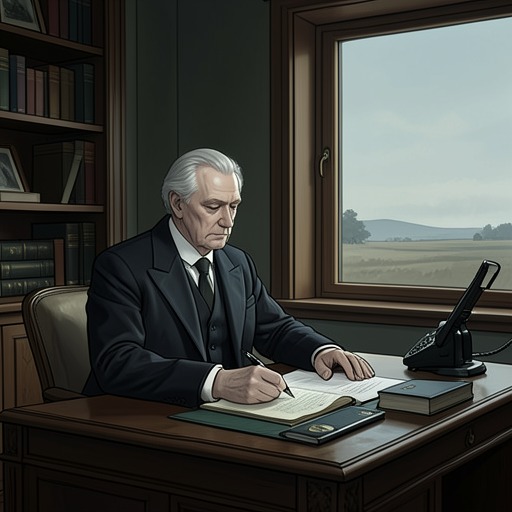
Aschenbach decides to travel south
Death in VeniceAschenbach decides to travel south after a chance encounter awakens a desire for distant places that his reason and long-practised discipline cannot entirely suppress. The decision interrupts a life organized around work and artistic self-command; its consequences carry him from Munich through an unsatisfactory island stay to Venice, where travel becomes both a change of scene and a new way of looking.
From Creative Impasse to Decision
Aschenbach has long treated travel as a hygienic necessity rather than a pleasure. He is too occupied by his work and intellectual preoccupations to seek the diversions of the wider world, and has rarely ventured beyond Europe. As his life declines, the fear that he may not finish his work has narrowed his outer existence to the beautiful city where he lives and a country house in the mountains. A stranger’s foreign appearance at the station unsettles that settled pattern: after meeting the stranger’s direct gaze, Aschenbach turns away, but soon finds himself seized by an unusually vivid longing for far-off places.
His first response is to rein in the impulse. Reason and the discipline he has practised since youth remind him of his plans to advance his life’s work before retreating to the country. Months spent travelling would mean neglecting it. Yet he recognizes that the desire is also an urge to escape the unremitting demands of production: he loves his work and its daily contest of will against weariness, but senses that stubbornly tightening his control would deny an appetite that has become difficult to ignore.
That appetite has a specific artistic context. Aschenbach’s craft remains secure, and the nation honours his work, but he is dissatisfied with what he produces. A fastidious inability to accept approximation has helped define his talent; now, however, he suspects that his emotional restraint may be leaving his art without the changing intensity that gives it life. He fears the prospect of another summer alone in the familiar mountain landscape, surrounded by boredom and discontent. A break, he concludes, might restore freshness and make the summer both endurable and productive. The plan is deliberately limited: not a far-reaching expedition, but a night on a sleeper train and three or four weeks at a popular southern resort.
The Journey Takes Shape
Literary and social obligations delay his departure for about two weeks after the walk in Munich. He orders his country house prepared for occupancy within a month, then takes a night train to Trieste between the middle and end of May. After a stop of only twenty-four hours, he embarks for Pola, seeking somewhere foreign and different yet quickly accessible.
The island he chooses does not satisfy the purpose of the trip. Its rugged cliffs and unfamiliar local life promise novelty, but rain, heavy weather, the hotel’s provincial clientele, and the absence of a soft sandy beach keep him from finding the rest he wants. He studies sailing dates and, a week and a half after arriving, recognizes that he has stopped short of his intended destination. A fast motorboat takes him and his luggage back to the naval port, where he crosses directly to a ship bound for Venice.
Arrival and the Changed Field of Attention
The ship’s arrival makes the journey itself part of the experience. Aschenbach sees Venice from the sea: the palaces, the Bridge of Sighs, the columns bearing the lion and saint, and the great clock form a spectacular approach. He considers arrival by rail an entrance through the back of a palace, unsuited to a city that seems unreal. He asks for a gondola to take him and his luggage to the landing for the steamers serving the Lido, intending to stay near the sea.
At the hotel, the change of setting gives him new scenes to observe. The guests assemble in the lobby in evening dress, their different nationalities and languages brought together in a shared social space. Among them he notices a beautiful Polish boy, whose appearance arrests him. On the beach, Aschenbach takes pleasure in a broader spectacle of resort life: children wade and swim, boats capsize amid laughter, guests move between bathing houses and the open sand, and a Russian family makes its camp beside the shore. The decision made in Munich to break from work has carried him into a place where looking at people and surroundings becomes a central part of his days.
The Journey’s Broader Stakes
Travel initially promises relief from the pressure of artistic discipline, but the narrative complicates that promise. The journey takes Aschenbach from his familiar city and mountain retreat into spaces organized for leisure and observation; it also brings him into contact with circumstances that exceed the holiday he sought. In Venice, the public appearance of a thriving resort conceals a serious cholera outbreak. The authorities suppress reports to protect business and the city’s tourist trade, even as cases multiply and the consequences of the epidemic disrupt the life of the city.
The contrast casts the original decision in a more consequential light. Aschenbach had set out for a short rest and a change of air, hoping to recover creative freshness; his movement south instead places him within a setting where the pleasures of travel coexist with concealed danger. What began as an attempt to escape the constraints of work becomes the threshold of an increasingly fraught experience.